Managing multiple large WiFi networks at different sites is a nightmare. Our client faced difficulties monitoring router devices, controlling user access, managing technician jobs, and maintaining the security of all activities at scale. To address this, we developed the Captive Portal Backend System, a centralized platform for easy WiFi hotspot management that remains scalable and secure.

Hours delivered back to the business
Team members
Project Overview
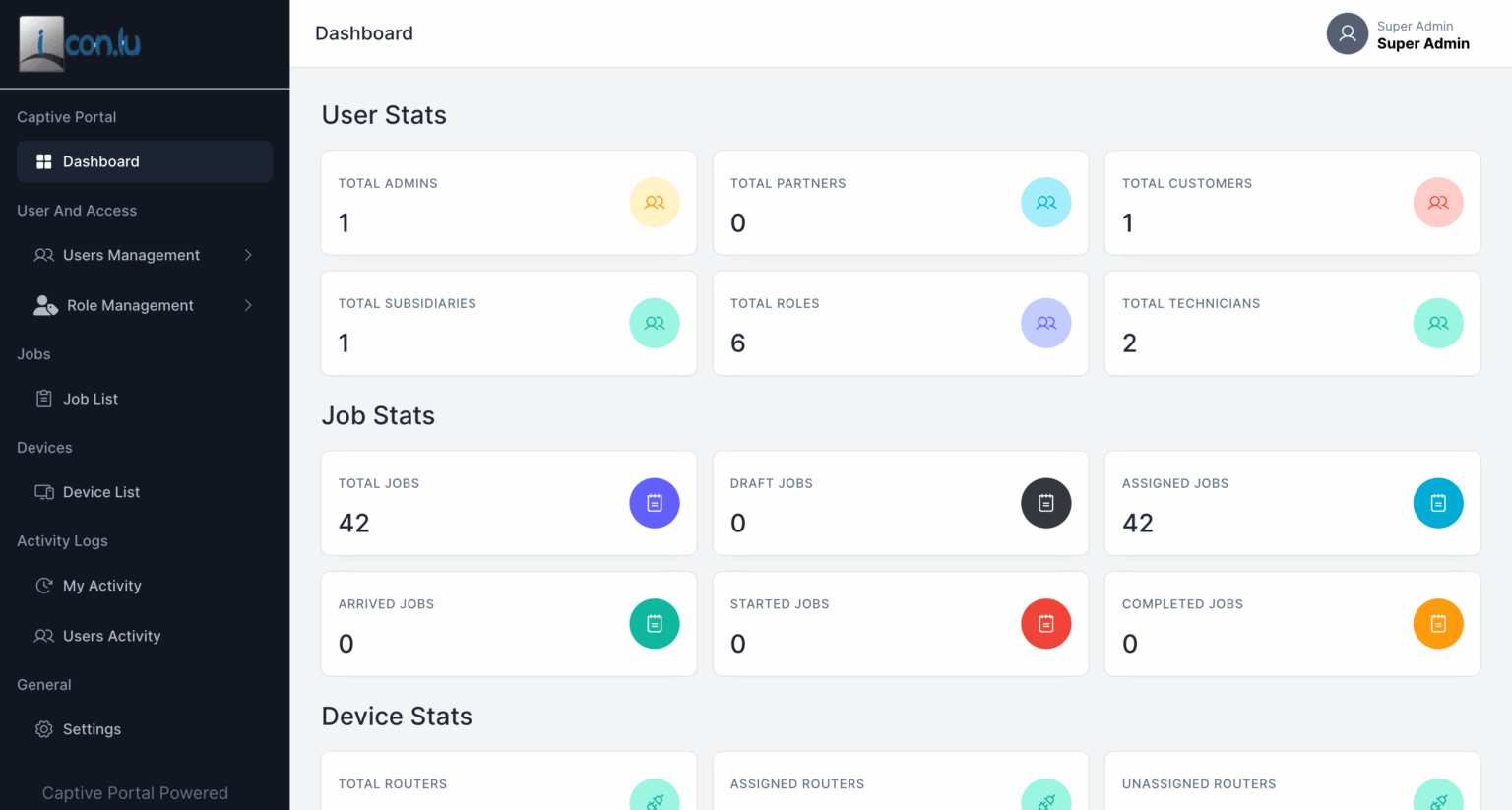
The Captive Portal Backend System is a cutting-edge web application based on a microservices architecture. It provides integrated management of router devices, captive portal configuration, user access, and field operations. The system is designed for real-time visibility, better control, and smooth operations at large WiFi deployments.
Challenge Faced
The client manages thousands of router devices deployed in different remote locations. Device monitoring was not consistent, and issues were often discovered very late. Job assignments were manual and not properly tracked for technicians. There was also a lack of structured access control and activity tracking, which complicated security and compliance.
Our Approach
The system is designed using backend services connected through a secure API gateway. Each router device will be registered with a unique identity and communicate with the platform in real-time using lightweight messaging. This allows network managers to monitor device health and network quality without visiting the place.
As mentioned in Captive portal settings, such as user login flow and access rules, can be configured centrally and pushed remotely to devices. This will help in reducing manual configuration effort and improving consistency across deployments.
Job & User Management
With an integrated job management module, full job lifecycle tracking is accomplished. The administrator can create jobs, assign technicians, record the details of the installation, track materials, and verify work through uploaded photos. This has brought clarity and accountability to field operations.
User security is governed through token-based authentication with role-based access control. Different user roles have controlled permissions, and all important actions are logged through a centralized activity log for auditing and troubleshooting.

Technology Overview
- Back-end in Node.js and front-end in React, Next.js
- Storage of data in MongoDB is to be flexible and scalable.
- Real-time updates on the dashboard through WebSockets. Centralized logging using structured logs for easier debugging.
- Real-time communication between routers using MQTT.
- REST APIs and gRPC for efficient service-to-service communication.
- Multi-language support using i18n for global usability.
Business Impact & Conclusion
The Captive Portal System enabled real-time monitoring, faster fault fixing, and automated job workflows, and transformed the organization into a more efficient operation. In addition, its architecture is scalable to make the emergence of more devices easy. Above all, managing complex WiFi networks has become a reliable and secure solution, easy to manage, and is constructed in favor of long-term growth for such businesses.