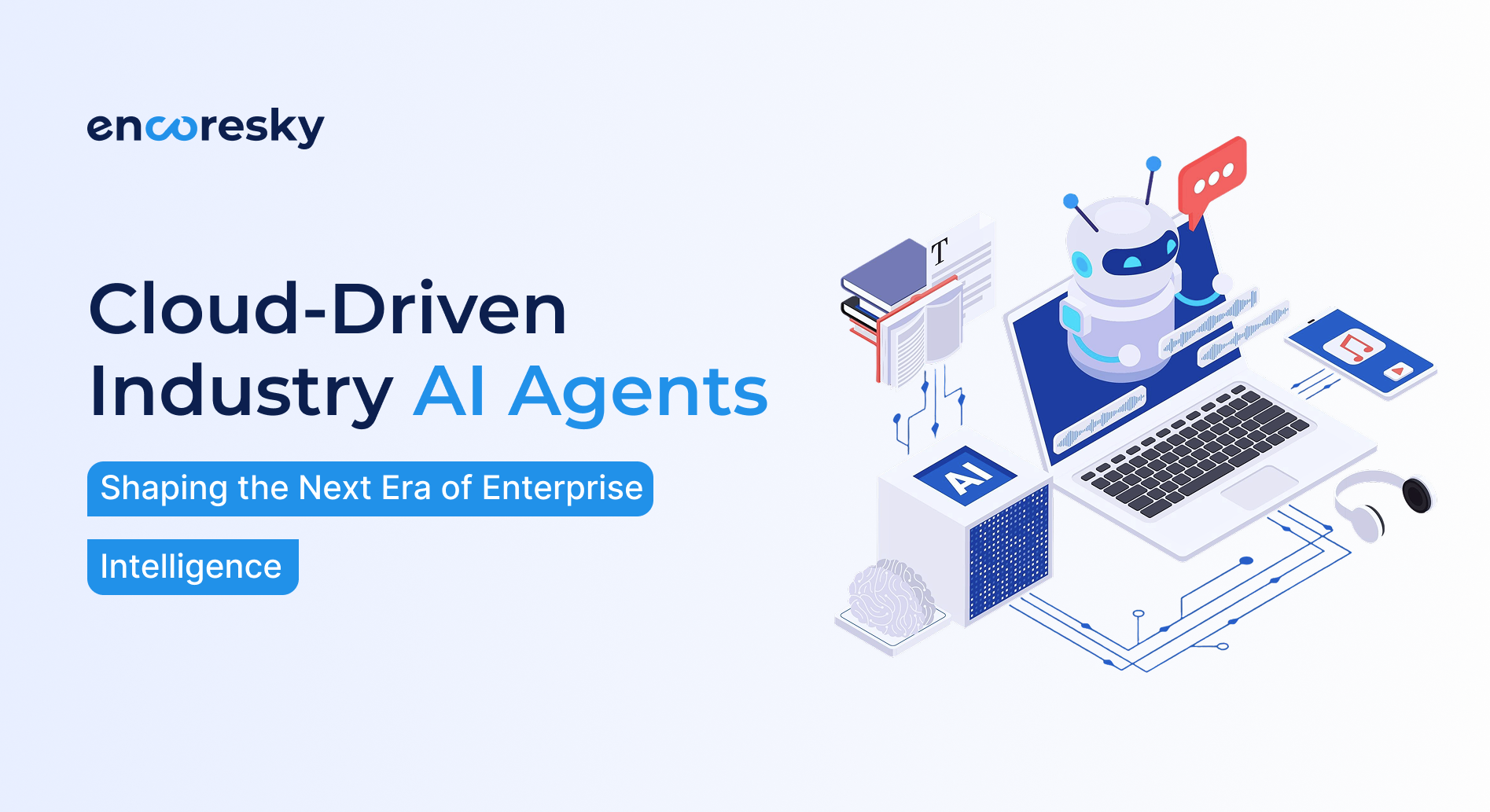
In 2026, AI and the cloud will lose their trendy status. They will finally come together in their upcoming incarnation as industry-oriented AI agents. Today’s general-purpose AI assistants cover a slate of use cases, and work well across a variety of applications-they can bust through walls. Next-generation AI agents, however, will be built, trained, and optimized for healthcare, finance, manufacturing, and retail. In exchange for those functionalities, enterprises can expect sharper insights, faster automation, and context-specific decisions.
What Are Industry-Specific AI Agents?
An industry-specific AI agent is a cloud-based intelligence agent built specifically for the data models, workflows, and regulatory requirements of a respective industry. For example:
- In healthcare, with AI agents capable of analyzing patient data to make disease-readiness predictions and facilitating clinical documentation, they often align with HIPAA regulations and privacy laws.
- For finance: They perform automation tasks on fraud detection and risk modeling checks and regulatory compliance.
- In the manufacturing industry, Artificial Intelligence agents surveil production lines, predict maintenance scheduling, and optimize current supply chains.
Why Cloud Is the Backbone of These AI Agents
- Real-time data access: Cloud integrations allow Artificial Intelligence agents to pull live data from ERP, CRM, and IoT systems — this is a must for continuous learning and insights.
- Security and Compliance: Major cloud providers now offer “sovereign” and” industry” clouds with preparedness for compliance frameworks for regulated areas.
- Seamless deployment: Cloud-native Artificial Intelligence agents can be globally updated and retrained without local infrastructure dependency.
The Impact Across Industries
- Healthcare:
Cloud-based Artificial Intelligence agents summarize patient histories, suggest diagnostic tests, and auto-draft insurance claims – easing administrative workload while ensuring data privacy. - Financial Services:
AI agents detect transaction anomalies, automate KYC, and deliver personalized investment insights. Cloud data lakes enable analysis of millions of records in seconds with high accuracy. - Manufacturing:
With hybrid cloud-edge systems, AI agents monitor machines in real time, predict breakdowns, and optimize production. They also track sustainability through energy and waste analytics. - Retail:
AI-powered retail agents use cloud analytics and customer data to personalize recommendations, automate inventory, and forecast demand more precisely
The Architecture: Cloud + AI Agents + Domain Data
The success of these agents depends on the integration of three key layers:
- AI Model Layer: Pre-trained on domain-specific datasets (e.g., medical images, financial transactions, or sensor data).
- Cloud Infrastructure Layer: Provides the compute, storage, and security backbone for scalable AI deployment.
- Data Integration Layer: Connects enterprise systems, APIs, and IoT feeds to create a continuous learning loop.
What’s Next: The Future of Vertical AI
By 2026, the government’s budget for cloud services with AI for specific industries would surpass the budget of generic services. Thus, we are entering a phase where AI will understand business operations by itself, driving factors such as the rules, risks, and language of each sector.
“Which of your industry AI agents runs your business?” Is what companies will soon ask instead of “Do you use AI?” This marks the start of vertical intelligence, a future in which cloud platforms can do much more than host data but offer deep, contextual decision-making for every industry.