Just imagine, a growing company decides to integrate with AI into its operations. The goal looks very simple: just build an intelligent assistant that can answer users’ questions, access internal documents, and help employees find information quickly.
A team chooses an LLM and starts testing. At first, everything looks promising.
But soon, problems appear.
The AI provides outdated answers. It doesn’t have an idea about the company’s latest policies. No detailed features are mentioned, so the customer support team can’t fully trust the process.
Now, should we use fine-tuning or RAG to improve AI Data?
This is a very common question that is frequently asked by businesses when implementing AI solutions today.
Let’s explore both approaches and understand which one is better and right for our business.
Understand the Problem
See, LLM models like ChatGPT, Claude, and Gemini use a large amount of data on public info to train themselves, although they do not have full information or access to your company like internal records, policies, Business processes, and private knowledge bases.
To make AI useful for enterprise applications, businesses typically choose the best one: RAG or Finetune.
What is RAG?
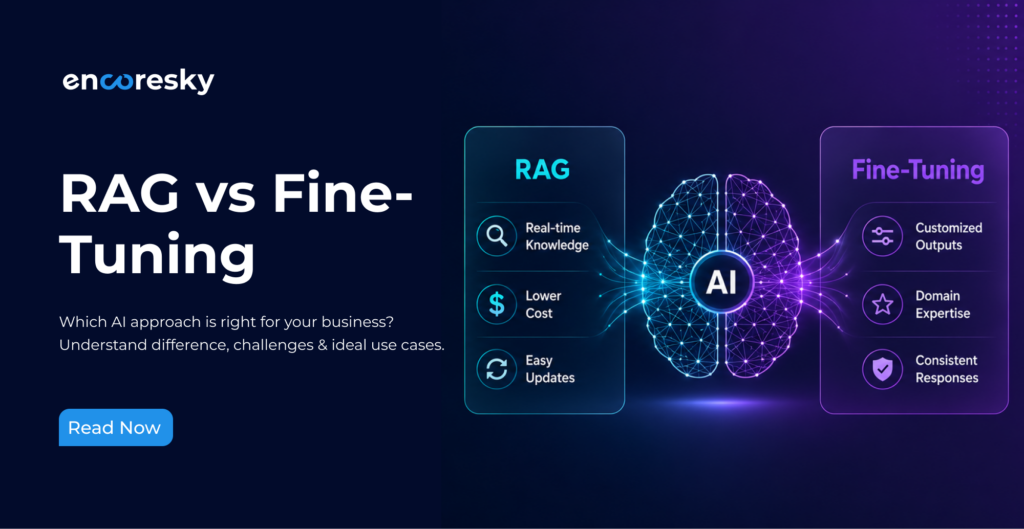
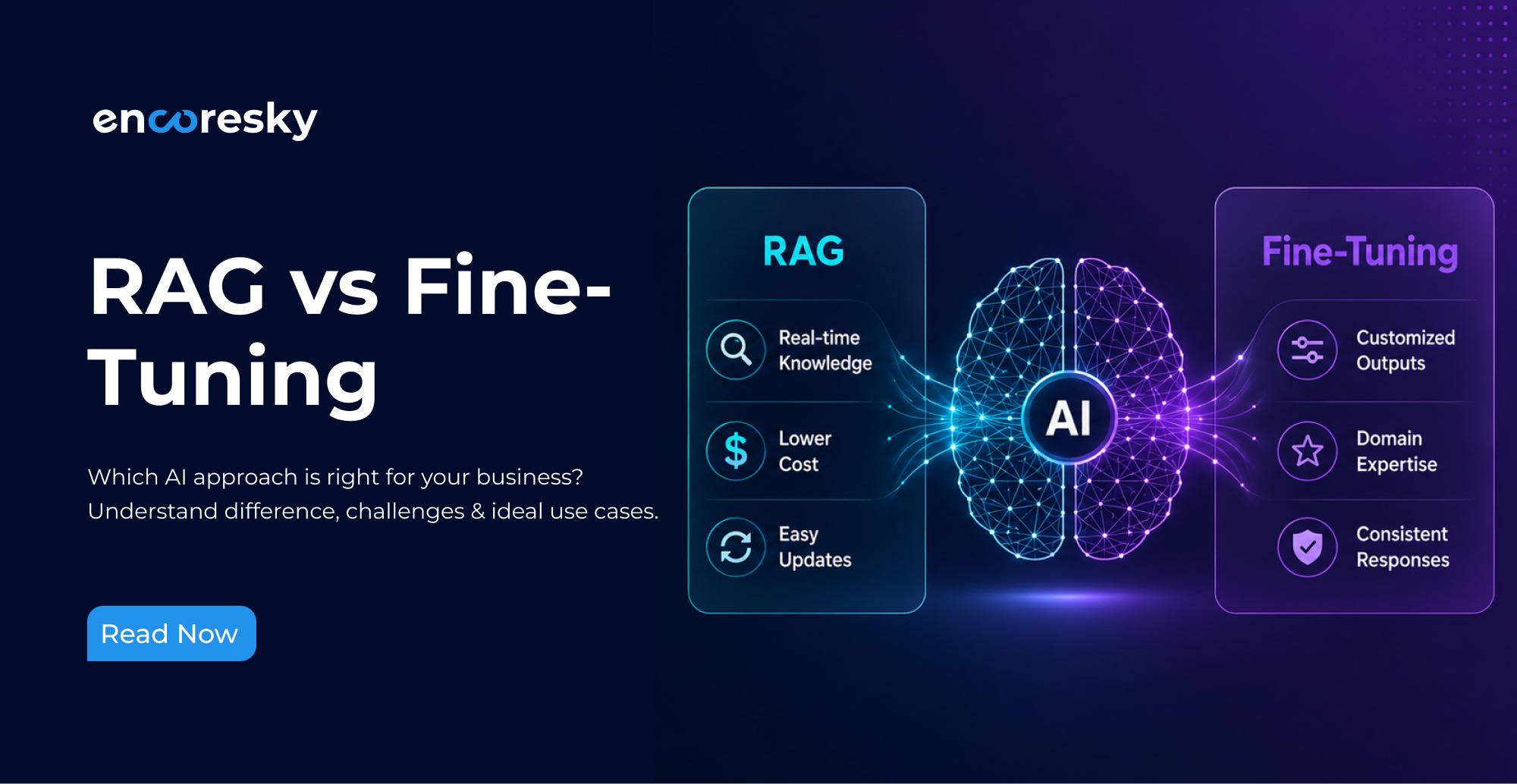
RAG means Retrieval-Augmented Generation, which helps AI to restore information from your documents, databases, and knowledge base in real time before generating a response.
For example:
A customer asks: “What’s the warranty time period for this phone?”
The AI first searches your latest product documentation, captures the relevant information, and then generates an accurate response based on that document. The answer comes from your current data and not from memory.
Best for:
- Internal knowledge assistants
- Customer support chatbots
- Enterprise search
- Document intelligence
Benefits:
- Access to up-to-date information
- Reduced hallucinations
- No retraining required when data changes
- Faster and more cost-effective deployment
What is Fine-Tuning?
Fine-tuning is a completely different approach. Instead of giving the AI access to documents during a conversation, you restore the model using your own data. Fine-Tuning trains an AI model on your specific data to improve how it responds and behaves.
Imagine training a customer support representative for months until they naturally understand your company’s tone, terminology, and workflows.
That’s essentially what fine-tuning does.
Best for:
- Industry-specific AI applications
- Brand voice customization
- Structured outputs
- Specialized workflows
Benefits:
- Better domain expertise
- Consistent responses
- Improved task-specific performance
Which one should you use?
Let’s be real and honest, you can choose both, as many advanced AI systems combine both approaches.
Together, they create a highly capable enterprise AI solution. This hybrid approach is becoming increasingly common among organizations deploying AI at scale.
Choose RAG if:
- Your information changes frequently
- You have large document repositories
- You need accurate and up-to-date answers
- You want faster deployment
- You want lower maintenance costs
Choose Fine-Tuning if:
- You need specialized behavior
- You require a unique brand voice
- You want structured outputs
- Your task requires deep domain adaptation
Choose Both if:
- You’re building enterprise-grade AI applications
- Accuracy and personalization are equally important
- You want the best possible user experience
Need RAG or Fine-Tuning Services?
At EncoreSky, we help businesses build scalable AI solutions with:
- RAG Pipeline Development
- LLM Fine-Tuning
- AI Agent Development
- Amazon Bedrock Solutions
- Vector Database Integration
- Enterprise AI Architecture
Contact us: info@encoresky.com
Build AI that understands your business.