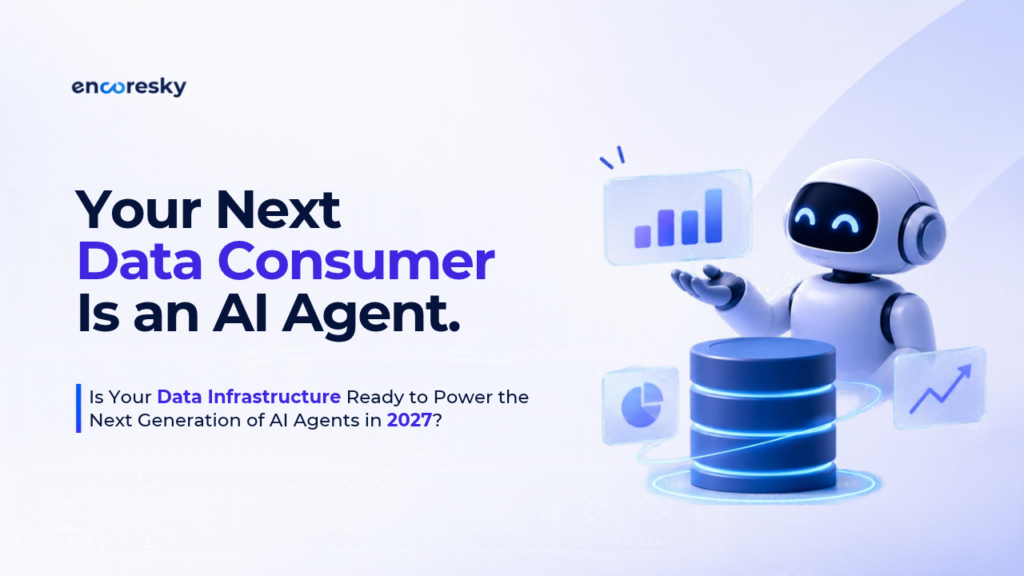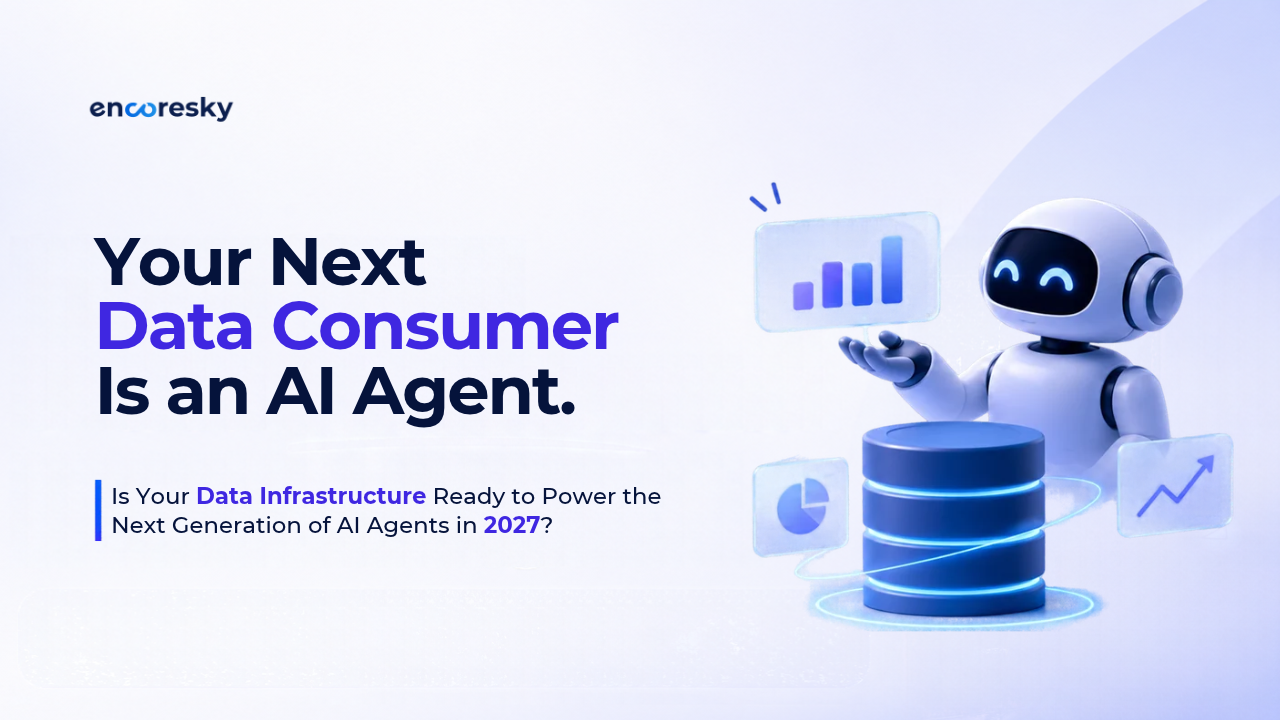
For twenty years, data teams built pipelines for people: analysts writing SQL, managers reading dashboards. Heading into 2027, a fast-growing share of the queries hitting your data warehouse come from AI agents. They answer questions in Slack, prepare weekly reports and trigger actions in other systems. Agents read data very differently from people, and most data platforms were not built for them.
What changes when the reader is a machine
A human analyst carries context that is never written down. They know “revenue” here means net of refunds. They know the orders_v2 table stopped updating in March. They know which of the three customer tables finance trusts. An AI agent knows none of this. It reads the schema, writes a query and returns a confident number.
That creates three new risks:
- Plausible but wrong answers. The SQL runs, a number comes back and nothing looks broken. The error only shows up when someone acts on it.
- Scale. One analyst makes a mistake once. An agent can repeat the same mistake thousands of times a day, for every user who asks.
- Action without review. Agents now do more than answer questions. They send emails, update records and adjust budgets based on what the data says.
The evidence: context beats a bigger model
In April 2026, dbt Labs published a benchmark comparing two approaches on the same business questions. In one, the model wrote SQL directly from the schema (text-to-SQL). In the other, it queried through a semantic layer, which is a governed set of metric and dimension definitions.
The results:
- Claude Sonnet 4.6: 90.0% accurate writing raw SQL, 98.2% through a semantic layer
- GPT-5.3 Codex: 84.1% accurate writing raw SQL, 100.0% through a semantic layer
These scores come from questions the semantic layer could answer, after the team added some basic data modelling. Raw text-to-SQL has improved a lot. Its overall accuracy on the benchmark nearly doubled, from 32.7% in 2023 to 64.5% in 2026. Even so, the bigger finding was how each approach fails. When a question was outside its scope, the semantic layer said it could not answer. Text-to-SQL could return a believable wrong number instead.
The lesson is not about any one tool. AI models are now good enough. What decides accuracy is the context your data platform gives them.
Six building blocks of agent-ready data
- One definition per metric. Revenue, active customer and churn should be defined once, in code, in a semantic layer. Agents should query those metric definitions, not rebuild them from raw tables each time.
- Descriptions a machine can read. Every important table and column needs a plain description, its unit, its grain (one row per what?) and its valid values. Your data catalog and metadata are now part of your AI stack.
- Modelled tables, not raw sources. Highly normalised source tables force an agent to guess joins. Clean, well-named data models give it fewer ways to go wrong. In the dbt benchmark, three new models were enough to cover every question.
- Freshness and quality signals. Show when each table was last updated and whether its data quality tests passed. A good agent should be able to say “this data is two days old” or refuse to answer from a failing table.
- Access control built for agents. Treat each agent as its own identity with least-privilege access. Apply row-level and column-level security, and log every query an agent runs so you can audit what it saw.
- Unstructured data pipelines. Agents also read documents, tickets, contracts and wikis. These need the same care as tables: chunking, embeddings kept in sync with the source, and permissions that travel with each chunk.
How to start without boiling the ocean
- Pick one domain. Choose the 20 questions one team, such as sales or finance, asks every week.
- Model and define the metrics those questions need. Usually this means 10 to 15 metrics and a handful of clean tables.
- Document them. Write descriptions, units and owners for every table and column involved.
- Build a test set. Write down the correct answer to each of the 20 questions, then measure how often the agent gets them right.
- Add guardrails. Set up agent-specific access, query logging and a rule that the agent says “I don’t know” rather than guess.
- Expand. Move to the next domain only when accuracy on the first is where the business needs it.
A quick data readiness check
- Could a new hire find the official definition of your top five metrics in under five minutes?
- Do your most-used tables have column descriptions?
- Can you tell, automatically, whether a table is stale?
- Can you see every query an AI tool ran against your data last week?
- Does each AI tool have its own access, or does it borrow a person’s?
If most of your answers are no, your data is not agent-ready yet, whatever AI model you choose.
The Takeaway
AI agents will not fix messy data. They will repeat its mistakes faster and with more confidence. The companies that get real value from AI in 2027 are investing in metric definitions, documentation, freshness signals and access control first, and connecting the agent last.
Planning to put AI agents on top of your company’s data? EncoreSky Technologies builds the data foundations they need, including semantic layers, data documentation, data quality checks and secure data access, so your agents give answers your team can trust. Get in touch to talk it through.